🚚 Free Worldwide Shipping on All Orders!Shop Now



Tomatillo Verde
-
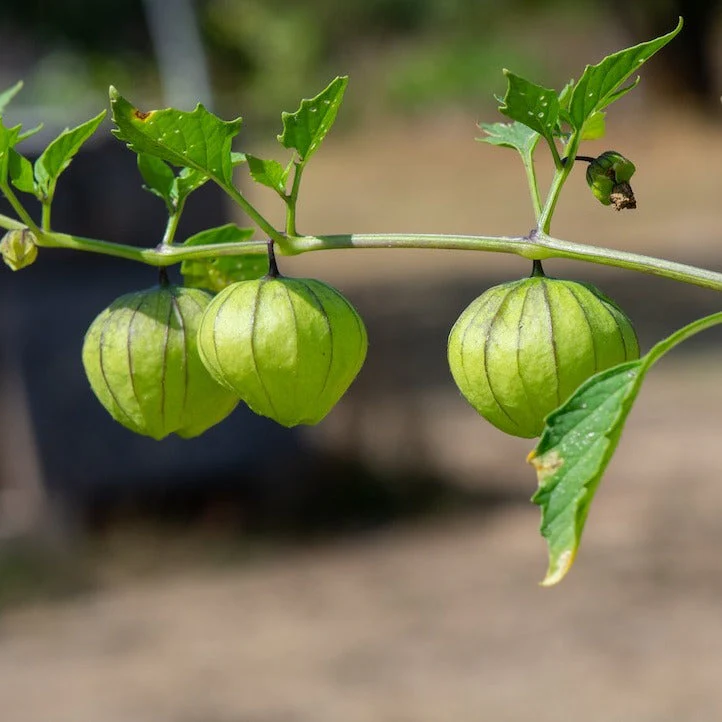
![]() Tomatillo 'Verde' is a vigorous, sun-loving fruiting plant known for its bright green husked fruits that are essential in traditional Mexican cuisine. A member of the Solanaceae family, closely related to tomatoes and ground cherries, it is native to Mexico and Central America, where it grows as a sprawling annual. The plant features soft, slightly fuzzy green stems and broad, lobed leaves, forming a bushy, spreading habit ideal for vegetable gardens and container growing. Its distinctive papery husks, called calyxes, enclose the developing fruits, offering a signature look during the growing season.
Tomatillo 'Verde' is a vigorous, sun-loving fruiting plant known for its bright green husked fruits that are essential in traditional Mexican cuisine. A member of the Solanaceae family, closely related to tomatoes and ground cherries, it is native to Mexico and Central America, where it grows as a sprawling annual. The plant features soft, slightly fuzzy green stems and broad, lobed leaves, forming a bushy, spreading habit ideal for vegetable gardens and container growing. Its distinctive papery husks, called calyxes, enclose the developing fruits, offering a signature look during the growing season.![]() Each plant typically grows 3 to 4 feet tall and can spread 2 to 3 feet wide under good conditions. Small, yellow flowers with dark centers appear at leaf axils before developing into the husk-covered fruits. As the fruits mature, they fill the husk and eventually split it when fully ripe, signaling the right time for harvest. Tomatillo 'Verde' produces firm, tart green fruits that are a key ingredient in salsas, sauces, and many cooked dishes, offering a tangy, slightly citrusy flavor.
Each plant typically grows 3 to 4 feet tall and can spread 2 to 3 feet wide under good conditions. Small, yellow flowers with dark centers appear at leaf axils before developing into the husk-covered fruits. As the fruits mature, they fill the husk and eventually split it when fully ripe, signaling the right time for harvest. Tomatillo 'Verde' produces firm, tart green fruits that are a key ingredient in salsas, sauces, and many cooked dishes, offering a tangy, slightly citrusy flavor.![]() Compared to similar species like ground cherries (Physalis pruinosa), Tomatillo 'Verde' fruits are larger, less sweet, and more savory. It requires another tomatillo plant nearby for successful pollination, as it is not reliably self-pollinating. This mutual pollination need makes it well-suited for garden groupings or planting alongside other vegetable crops. Its vigorous growth and spreading nature can fill open spaces quickly, making it both productive and decorative in edible landscapes.
Compared to similar species like ground cherries (Physalis pruinosa), Tomatillo 'Verde' fruits are larger, less sweet, and more savory. It requires another tomatillo plant nearby for successful pollination, as it is not reliably self-pollinating. This mutual pollination need makes it well-suited for garden groupings or planting alongside other vegetable crops. Its vigorous growth and spreading nature can fill open spaces quickly, making it both productive and decorative in edible landscapes.![]() While Tomatillo 'Verde' is grown mainly for its culinary fruits, the plant itself adds visual interest with its lantern-like husks and lush foliage. In warmer climates, it can be grown outdoors throughout the season, while in cooler regions it is often started indoors and transplanted after frost danger passes. Though related to the tomato, it tends to be slightly more tolerant of drought once established, producing reliably even under varying summer conditions.
While Tomatillo 'Verde' is grown mainly for its culinary fruits, the plant itself adds visual interest with its lantern-like husks and lush foliage. In warmer climates, it can be grown outdoors throughout the season, while in cooler regions it is often started indoors and transplanted after frost danger passes. Though related to the tomato, it tends to be slightly more tolerant of drought once established, producing reliably even under varying summer conditions.
-
![]() Requires full sun, receiving at least 6 to 8 hours of direct sunlight daily for strong fruit production. Insufficient light leads to weak stems and fewer fruits.
Requires full sun, receiving at least 6 to 8 hours of direct sunlight daily for strong fruit production. Insufficient light leads to weak stems and fewer fruits.![]() Water regularly, keeping the soil evenly moist but not waterlogged. Allow the top inch of soil to dry slightly between waterings to avoid root rot.
Water regularly, keeping the soil evenly moist but not waterlogged. Allow the top inch of soil to dry slightly between waterings to avoid root rot.![]() Adapts well to average outdoor humidity levels. Good air circulation around the plant helps reduce the risk of fungal diseases.
Adapts well to average outdoor humidity levels. Good air circulation around the plant helps reduce the risk of fungal diseases.![]() Prefers temperatures between 70–85°F for vigorous growth. It is frost-sensitive and should be planted only after the danger of frost has passed.
Prefers temperatures between 70–85°F for vigorous growth. It is frost-sensitive and should be planted only after the danger of frost has passed.![]() Grows best in a rich, well-draining soil, preferably loamy and slightly acidic to neutral (pH 6.0–7.0). Adding compost improves soil fertility and fruit yield.
Grows best in a rich, well-draining soil, preferably loamy and slightly acidic to neutral (pH 6.0–7.0). Adding compost improves soil fertility and fruit yield.![]() Feed once every 4–6 weeks with a balanced fertilizer to support strong vegetative growth and fruit production. Avoid excessive nitrogen, which encourages leafy growth over fruiting.
Feed once every 4–6 weeks with a balanced fertilizer to support strong vegetative growth and fruit production. Avoid excessive nitrogen, which encourages leafy growth over fruiting.![]() Tomatillo 'Verde' fruits are edible when ripe, but unripe fruits and green plant parts (especially leaves and stems) contain solanine and can be toxic if consumed in large amounts. Only harvest and eat fully ripened fruits.
Tomatillo 'Verde' fruits are edible when ripe, but unripe fruits and green plant parts (especially leaves and stems) contain solanine and can be toxic if consumed in large amounts. Only harvest and eat fully ripened fruits.![]() Hardy outdoors as an annual in USDA zones 3–11. In all zones, it must be replanted each year after the last frost. While tomatoes are generally grown as annuals and can be cultivated in USDA zones 3 through 11, the key factor is the length of the growing season and the average last frost date in your specific area. In cooler zones like 3 and 4, gardeners often start seeds indoors and use season-extending techniques to ensure a successful harvest.
Hardy outdoors as an annual in USDA zones 3–11. In all zones, it must be replanted each year after the last frost. While tomatoes are generally grown as annuals and can be cultivated in USDA zones 3 through 11, the key factor is the length of the growing season and the average last frost date in your specific area. In cooler zones like 3 and 4, gardeners often start seeds indoors and use season-extending techniques to ensure a successful harvest.
-
Zone 3-11
![]()
 Tomatillo 'Verde' is a vigorous, sun-loving fruiting plant known for its bright green husked fruits that are essential in traditional Mexican cuisine. A member of the Solanaceae family, closely related to tomatoes and ground cherries, it is native to Mexico and Central America, where it grows as a sprawling annual. The plant features soft, slightly fuzzy green stems and broad, lobed leaves, forming a bushy, spreading habit ideal for vegetable gardens and container growing. Its distinctive papery husks, called calyxes, enclose the developing fruits, offering a signature look during the growing season.
 Each plant typically grows 3 to 4 feet tall and can spread 2 to 3 feet wide under good conditions. Small, yellow flowers with dark centers appear at leaf axils before developing into the husk-covered fruits. As the fruits mature, they fill the husk and eventually split it when fully ripe, signaling the right time for harvest. Tomatillo 'Verde' produces firm, tart green fruits that are a key ingredient in salsas, sauces, and many cooked dishes, offering a tangy, slightly citrusy flavor.
 Compared to similar species like ground cherries (Physalis pruinosa), Tomatillo 'Verde' fruits are larger, less sweet, and more savory. It requires another tomatillo plant nearby for successful pollination, as it is not reliably self-pollinating. This mutual pollination need makes it well-suited for garden groupings or planting alongside other vegetable crops. Its vigorous growth and spreading nature can fill open spaces quickly, making it both productive and decorative in edible landscapes.
 Requires full sun, receiving at least 6 to 8 hours of direct sunlight daily for strong fruit production. Insufficient light leads to weak stems and fewer fruits.
 Prefers temperatures between 70–85°F for vigorous growth. It is frost-sensitive and should be planted only after the danger of frost has passed.
 Tomatillo 'Verde' fruits are edible when ripe, but unripe fruits and green plant parts (especially leaves and stems) contain solanine and can be toxic if consumed in large amounts. Only harvest and eat fully ripened fruits.
Select Size
Select Style
From $2.90
Original: $9.65
-70%Tomatillo Verde—
$9.65
$2.90Product Information
Product Information
Shipping & Returns
Shipping & Returns
Description
-
![]() Tomatillo 'Verde' is a vigorous, sun-loving fruiting plant known for its bright green husked fruits that are essential in traditional Mexican cuisine. A member of the Solanaceae family, closely related to tomatoes and ground cherries, it is native to Mexico and Central America, where it grows as a sprawling annual. The plant features soft, slightly fuzzy green stems and broad, lobed leaves, forming a bushy, spreading habit ideal for vegetable gardens and container growing. Its distinctive papery husks, called calyxes, enclose the developing fruits, offering a signature look during the growing season.
Tomatillo 'Verde' is a vigorous, sun-loving fruiting plant known for its bright green husked fruits that are essential in traditional Mexican cuisine. A member of the Solanaceae family, closely related to tomatoes and ground cherries, it is native to Mexico and Central America, where it grows as a sprawling annual. The plant features soft, slightly fuzzy green stems and broad, lobed leaves, forming a bushy, spreading habit ideal for vegetable gardens and container growing. Its distinctive papery husks, called calyxes, enclose the developing fruits, offering a signature look during the growing season.![]() Each plant typically grows 3 to 4 feet tall and can spread 2 to 3 feet wide under good conditions. Small, yellow flowers with dark centers appear at leaf axils before developing into the husk-covered fruits. As the fruits mature, they fill the husk and eventually split it when fully ripe, signaling the right time for harvest. Tomatillo 'Verde' produces firm, tart green fruits that are a key ingredient in salsas, sauces, and many cooked dishes, offering a tangy, slightly citrusy flavor.
Each plant typically grows 3 to 4 feet tall and can spread 2 to 3 feet wide under good conditions. Small, yellow flowers with dark centers appear at leaf axils before developing into the husk-covered fruits. As the fruits mature, they fill the husk and eventually split it when fully ripe, signaling the right time for harvest. Tomatillo 'Verde' produces firm, tart green fruits that are a key ingredient in salsas, sauces, and many cooked dishes, offering a tangy, slightly citrusy flavor.![]() Compared to similar species like ground cherries (Physalis pruinosa), Tomatillo 'Verde' fruits are larger, less sweet, and more savory. It requires another tomatillo plant nearby for successful pollination, as it is not reliably self-pollinating. This mutual pollination need makes it well-suited for garden groupings or planting alongside other vegetable crops. Its vigorous growth and spreading nature can fill open spaces quickly, making it both productive and decorative in edible landscapes.
Compared to similar species like ground cherries (Physalis pruinosa), Tomatillo 'Verde' fruits are larger, less sweet, and more savory. It requires another tomatillo plant nearby for successful pollination, as it is not reliably self-pollinating. This mutual pollination need makes it well-suited for garden groupings or planting alongside other vegetable crops. Its vigorous growth and spreading nature can fill open spaces quickly, making it both productive and decorative in edible landscapes.![]() While Tomatillo 'Verde' is grown mainly for its culinary fruits, the plant itself adds visual interest with its lantern-like husks and lush foliage. In warmer climates, it can be grown outdoors throughout the season, while in cooler regions it is often started indoors and transplanted after frost danger passes. Though related to the tomato, it tends to be slightly more tolerant of drought once established, producing reliably even under varying summer conditions.
While Tomatillo 'Verde' is grown mainly for its culinary fruits, the plant itself adds visual interest with its lantern-like husks and lush foliage. In warmer climates, it can be grown outdoors throughout the season, while in cooler regions it is often started indoors and transplanted after frost danger passes. Though related to the tomato, it tends to be slightly more tolerant of drought once established, producing reliably even under varying summer conditions.
-
![]() Requires full sun, receiving at least 6 to 8 hours of direct sunlight daily for strong fruit production. Insufficient light leads to weak stems and fewer fruits.
Requires full sun, receiving at least 6 to 8 hours of direct sunlight daily for strong fruit production. Insufficient light leads to weak stems and fewer fruits.![]() Water regularly, keeping the soil evenly moist but not waterlogged. Allow the top inch of soil to dry slightly between waterings to avoid root rot.
Water regularly, keeping the soil evenly moist but not waterlogged. Allow the top inch of soil to dry slightly between waterings to avoid root rot.![]() Adapts well to average outdoor humidity levels. Good air circulation around the plant helps reduce the risk of fungal diseases.
Adapts well to average outdoor humidity levels. Good air circulation around the plant helps reduce the risk of fungal diseases.![]() Prefers temperatures between 70–85°F for vigorous growth. It is frost-sensitive and should be planted only after the danger of frost has passed.
Prefers temperatures between 70–85°F for vigorous growth. It is frost-sensitive and should be planted only after the danger of frost has passed.![]() Grows best in a rich, well-draining soil, preferably loamy and slightly acidic to neutral (pH 6.0–7.0). Adding compost improves soil fertility and fruit yield.
Grows best in a rich, well-draining soil, preferably loamy and slightly acidic to neutral (pH 6.0–7.0). Adding compost improves soil fertility and fruit yield.![]() Feed once every 4–6 weeks with a balanced fertilizer to support strong vegetative growth and fruit production. Avoid excessive nitrogen, which encourages leafy growth over fruiting.
Feed once every 4–6 weeks with a balanced fertilizer to support strong vegetative growth and fruit production. Avoid excessive nitrogen, which encourages leafy growth over fruiting.![]() Tomatillo 'Verde' fruits are edible when ripe, but unripe fruits and green plant parts (especially leaves and stems) contain solanine and can be toxic if consumed in large amounts. Only harvest and eat fully ripened fruits.
Tomatillo 'Verde' fruits are edible when ripe, but unripe fruits and green plant parts (especially leaves and stems) contain solanine and can be toxic if consumed in large amounts. Only harvest and eat fully ripened fruits.![]() Hardy outdoors as an annual in USDA zones 3–11. In all zones, it must be replanted each year after the last frost. While tomatoes are generally grown as annuals and can be cultivated in USDA zones 3 through 11, the key factor is the length of the growing season and the average last frost date in your specific area. In cooler zones like 3 and 4, gardeners often start seeds indoors and use season-extending techniques to ensure a successful harvest.
Hardy outdoors as an annual in USDA zones 3–11. In all zones, it must be replanted each year after the last frost. While tomatoes are generally grown as annuals and can be cultivated in USDA zones 3 through 11, the key factor is the length of the growing season and the average last frost date in your specific area. In cooler zones like 3 and 4, gardeners often start seeds indoors and use season-extending techniques to ensure a successful harvest.
-
Zone 3-11
![]()