🚚 Free Worldwide Shipping on All Orders!Shop Now



Fatsia 'Spider's Web'
-
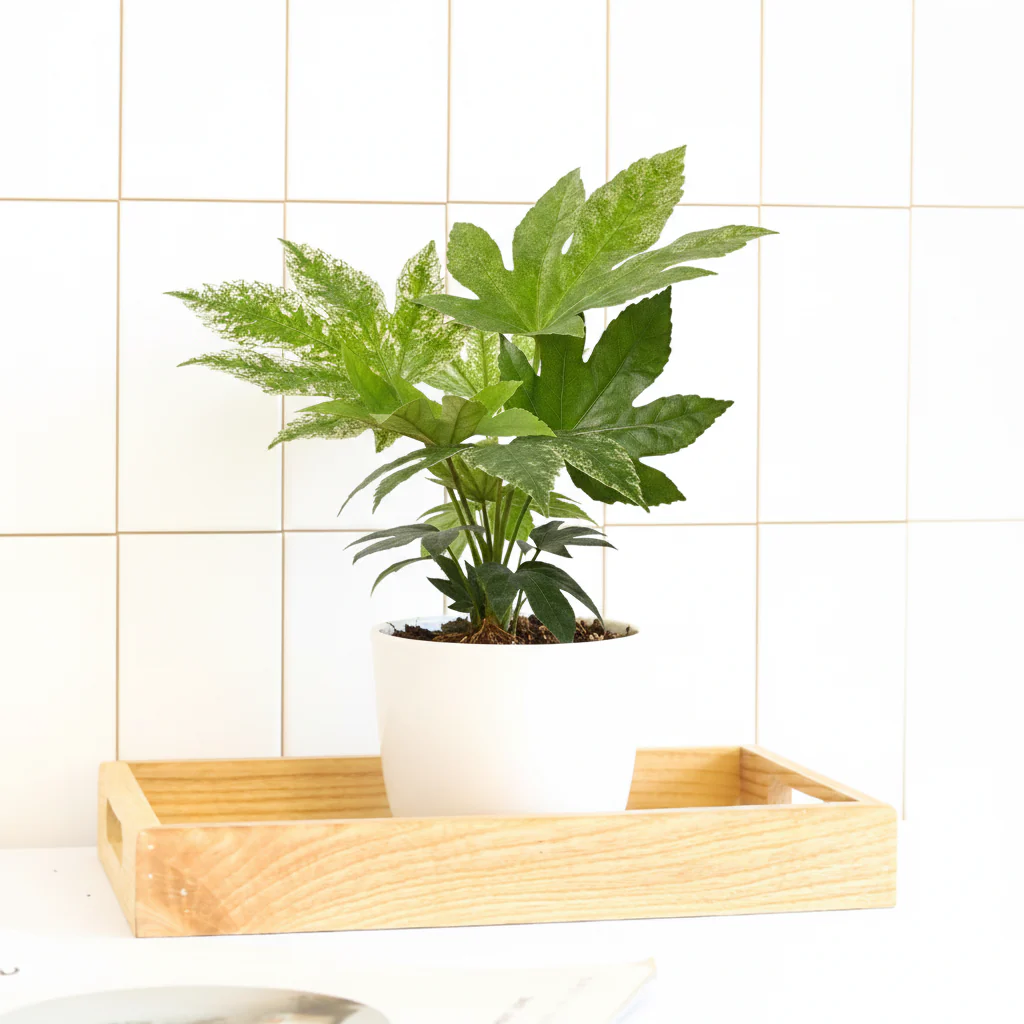
![]() The Fatsia japonica 'Spider's Web' (Variegated Japanese Aralia) is a unique, variegated cultivar of Fatsia japonica, a semi-dense, broadleaf, evergreen shrub. Also known as Speckled Japanese Aralia or Paperplant.
The Fatsia japonica 'Spider's Web' (Variegated Japanese Aralia) is a unique, variegated cultivar of Fatsia japonica, a semi-dense, broadleaf, evergreen shrub. Also known as Speckled Japanese Aralia or Paperplant.![]() This cultivar was selected and named in Japan by Mr. Hirose. The species (Fatsia japonica) is native to southern Japan and Korea.
This cultivar was selected and named in Japan by Mr. Hirose. The species (Fatsia japonica) is native to southern Japan and Korea.![]() Its large, glossy, deep green leaves are dusted and splattered with a creamy-white variegation, especially near the edges, which often improves and changes as the plant ages. In the fall (September/October), mature plants produce spherical clusters (umbels) of small, creamy-white flowers, which are followed by small, inedible black fruit in the winter. These flowers are an excellent source of nectar for late-season pollinators.
Its large, glossy, deep green leaves are dusted and splattered with a creamy-white variegation, especially near the edges, which often improves and changes as the plant ages. In the fall (September/October), mature plants produce spherical clusters (umbels) of small, creamy-white flowers, which are followed by small, inedible black fruit in the winter. These flowers are an excellent source of nectar for late-season pollinators.
-
![]() Thrives in part shade to full shade. The ideal spot offers bright, indirect light or morning sun. Avoid direct afternoon sun, especially in warmer climates, as it can easily scorch and brown the stunning variegated leaves.
Thrives in part shade to full shade. The ideal spot offers bright, indirect light or morning sun. Avoid direct afternoon sun, especially in warmer climates, as it can easily scorch and brown the stunning variegated leaves.![]() Keep the soil consistently moist but never soggy. Allow the top few inches of soil to dry out halfway between waterings.
Keep the soil consistently moist but never soggy. Allow the top few inches of soil to dry out halfway between waterings.![]() Use a moist, well-draining, rich soil high in organic matter.
Use a moist, well-draining, rich soil high in organic matter.![]() This plant thrives in warm, indoor environments between of 60 °F- 80 °F.
This plant thrives in warm, indoor environments between of 60 °F- 80 °F.
-
![]() USDA Zone 7-9
USDA Zone 7-9USDA Zone 9b: to -3.8 °C (25 °F)
USDA Zone 10a: to -1.1 °C (30 °F)
USDA Zone 10b: to 1.7 °C (35 °F)
USDA Zone 11: above 4.5 °C (40 °F)
 The Fatsia japonica 'Spider's Web' (Variegated Japanese Aralia) is a unique, variegated cultivar of Fatsia japonica, a semi-dense, broadleaf, evergreen shrub. Also known as Speckled Japanese Aralia or Paperplant.
 This cultivar was selected and named in Japan by Mr. Hirose. The species (Fatsia japonica) is native to southern Japan and Korea.
 Thrives in part shade to full shade. The ideal spot offers bright, indirect light or morning sun. Avoid direct afternoon sun, especially in warmer climates, as it can easily scorch and brown the stunning variegated leaves.
 Keep the soil consistently moist but never soggy. Allow the top few inches of soil to dry out halfway between waterings.
 Use a moist, well-draining, rich soil high in organic matter.
 USDA Zone 7-9
$41.00
Fatsia 'Spider's Web'—
$41.00
Product Information
Product Information
Shipping & Returns
Shipping & Returns
Description
-
![]() The Fatsia japonica 'Spider's Web' (Variegated Japanese Aralia) is a unique, variegated cultivar of Fatsia japonica, a semi-dense, broadleaf, evergreen shrub. Also known as Speckled Japanese Aralia or Paperplant.
The Fatsia japonica 'Spider's Web' (Variegated Japanese Aralia) is a unique, variegated cultivar of Fatsia japonica, a semi-dense, broadleaf, evergreen shrub. Also known as Speckled Japanese Aralia or Paperplant.![]() This cultivar was selected and named in Japan by Mr. Hirose. The species (Fatsia japonica) is native to southern Japan and Korea.
This cultivar was selected and named in Japan by Mr. Hirose. The species (Fatsia japonica) is native to southern Japan and Korea.![]() Its large, glossy, deep green leaves are dusted and splattered with a creamy-white variegation, especially near the edges, which often improves and changes as the plant ages. In the fall (September/October), mature plants produce spherical clusters (umbels) of small, creamy-white flowers, which are followed by small, inedible black fruit in the winter. These flowers are an excellent source of nectar for late-season pollinators.
Its large, glossy, deep green leaves are dusted and splattered with a creamy-white variegation, especially near the edges, which often improves and changes as the plant ages. In the fall (September/October), mature plants produce spherical clusters (umbels) of small, creamy-white flowers, which are followed by small, inedible black fruit in the winter. These flowers are an excellent source of nectar for late-season pollinators.
-
![]() Thrives in part shade to full shade. The ideal spot offers bright, indirect light or morning sun. Avoid direct afternoon sun, especially in warmer climates, as it can easily scorch and brown the stunning variegated leaves.
Thrives in part shade to full shade. The ideal spot offers bright, indirect light or morning sun. Avoid direct afternoon sun, especially in warmer climates, as it can easily scorch and brown the stunning variegated leaves.![]() Keep the soil consistently moist but never soggy. Allow the top few inches of soil to dry out halfway between waterings.
Keep the soil consistently moist but never soggy. Allow the top few inches of soil to dry out halfway between waterings.![]() Use a moist, well-draining, rich soil high in organic matter.
Use a moist, well-draining, rich soil high in organic matter.![]() This plant thrives in warm, indoor environments between of 60 °F- 80 °F.
This plant thrives in warm, indoor environments between of 60 °F- 80 °F.
-
![]() USDA Zone 7-9
USDA Zone 7-9USDA Zone 9b: to -3.8 °C (25 °F)
USDA Zone 10a: to -1.1 °C (30 °F)
USDA Zone 10b: to 1.7 °C (35 °F)
USDA Zone 11: above 4.5 °C (40 °F)